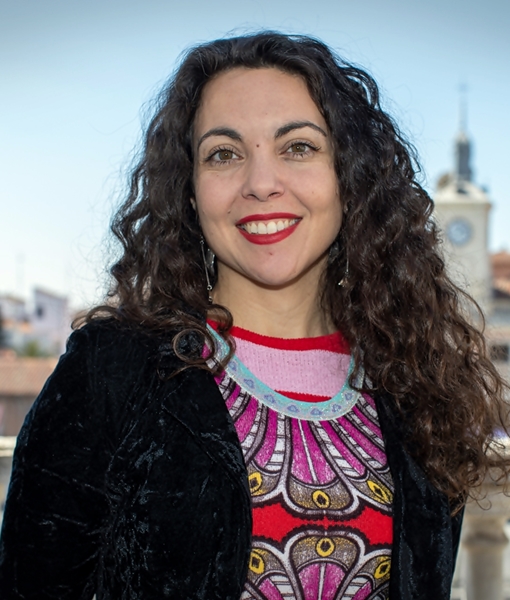
Prof. dr. Raquel Lázaro Gutiérrez
FITISPos-UAH Group, University of Alcalá (Spain)
Raquel Lázaro Gutiérrez is Professor of Translation and Interpreting at the University of Alcalá. She has been a member of the FITISPos-UAH Research Group (Training and Research in Public Service Translation and Interpreting) since 2001, and of Brussels Institute for Applied Linguistics and Brussels Centre for Urban Studies. She is a founding member of the Association of Trainers, Researchers, and Professionals of Public Service Translation and Interpreting, and of the European Network of Public Service Interpreting and Translation. She has received an award for research in European projects and three awards for knowledge transfer. She is the Director of the Digital Humanities Cluster of the Community of Madrid and Coordinator of the Digital Humanities and Language Technologies Platform of the University of Alcalá. She also serves as Vice-President of the European Network of Public Service Interpreting and Translation, based in Brussels; and is a member of the advisory board of the Interpreting SAFE-AI task force, based in Washington.
Public Service Interpreting and Technology: Challenges, Opportunities, and Controversies
Many public service interpreters started their careers as onsite bilateral interpreters who seldomly made use of technology for their assignments. However, technology advances in the last decades made telephone performance increasingly popular. Accepting remote assignments was something many public service interpreters were obliged to do, particularly after the COVID-19 pandemic. Nowadays, there are interpreters whose expertise in telephone assignments is higher than in onsite ones. Authors like Spinolo (2022: 7) point to the appearance of ‘video-mediated dialogue interpreting’ as an alternative (or complement) for telephone interpreting in service provision settings.
We could argue that interpretation is a highly technologized activity. However, there is certain reluctance about the use of technology amongst interpreters, particularly about remote interpreting technologies and in public service settings. The appearance of remote interpreting and the introduction of computer assisted interpreting (CAI) tools imply not only a change in the abilities interpreters need, but also a shift in working conditions. Machine translation, automatic speech recognition (ASR), term extraction, conversion, and so on, have gained popularity, not only for the preparation of assignments, but also for their delivery as these are now offered remotely from desktops instead as onsite. Still a challenge for public service interpreters, the use of technologies, such as artificial notepads, which combine note-taking applications with ASR, or other useful CAI tools for the management of numbers, terminology and other named entities is more than possible in a near future.
The technological turn in interpreting means not only a change in our professional culture. It also implies division between those who advocate for an increased use of technology and the ones who point at ethical and ergonomic challenges. Public service interpreters devote their careers to bridging communication gaps, reducing asymmetries and facilitating access to public services for usually underserved populations. This talk will bring reflection and discussion over the reasons behind the scarce adoption of technology by public service interpreters.
References:
Spinolo, N. 2022. Remote Interpreting. In ENTI (Encyclopedia of Translation & Interpreting). AIETI.