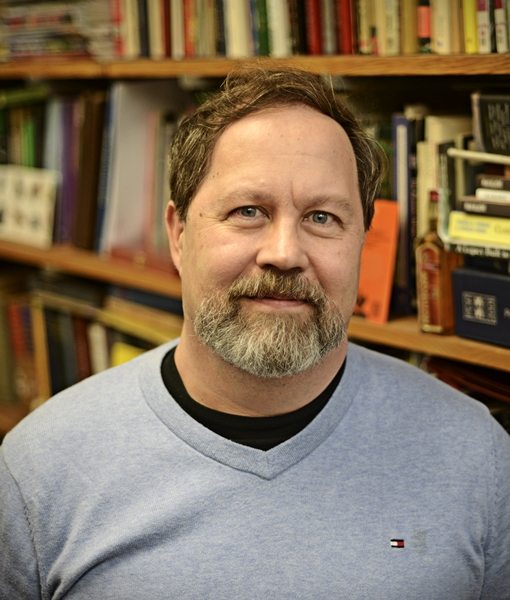
Prof. dr. Brian James Baer
Kent State University (USA)
Brian James Baer is Professor of Russian and Translation Studies at Kent State University. He is founding editor of the journal Translation and Interpreting Studies, and co-editor of the Bloomsbury book series Literatures, Cultures, Translation, with Michelle Woods, and of the Routledge book series Translation Studies in Translation, with Yifan Zhu. He publishes widely on translation history, translation pedagogy and translation theory. His most recent publications include the monographs Translation and the Making of Modern Russian Literature (2016) and Queer Theory and Translation Studies: Language, Politics, Desire (2020); the collected volumes Researching Translation and Interpreting, with Claudia Angelelli (2015), Translation in Russian Contexts, with Susanna Witt (2018), and Queering Translation, Translating the Queer, with Klaus Kaindl (2018); and the translations Culture, Memory and History: Essays in Cultural Semiotics, by Juri Lotman, and Introduction to Translation Theory, by Andrei Fedorov. He is current president of the American Translation and Interpreting Studies Association and sits on the international advisory board of the Nida Centre for Advanced Research in Translation in Rimini.
Queering the Cold War Canon, or Translation and the Making of a Queer World Literature
Although the 1950s in the US witnessed the so-called Lavender Scare, which saw the firing of thousands of individuals suspected of being homosexual from positions in the US government, a confluence of circumstances led the emergence of a queer World Literature, even before the Stonewall Riot of 1969, which galvanized the gay liberation movement. This paper addresses the circuitous path to canonization travelled by four literary works in translation: Jean Genet’s Our Lady of the Flowers, Yukio Mishima’s Confessions of a Mask, Pai Hsien-yung’s Crystal Boys, and José Lezama Lima’s Paradiso. The paper situates the process of canonization in the context of Cold War political rhetoric while also highlighting demonstrates the role of emerging queer networks of translators, editors, and publishers.